 Arbidex
 uses Classic and Quantum liquidity for token swaps on Arbitrum
Arbidex supports token swaps on Arbitrum through Classic pools and Quantum pools with configurable price ranges. Quantum liquidity earns trading fees only while the market price stays within the position's selected range. Classic spreads paired liquidity across the full price range and supports Zap deposits, which rebalance a single-token input before adding it to a pool. ARX staking, farms, and automated strategies serve separate roles in fee distribution and liquidity management.
Swaps across Classic and Quantum
Smart Order Routing (SOR) evaluates prices in Classic and Quantum pools alongside gas costs and slippage.
Routing across pools
The router supports multi-hop and split routing. A route can pass through intermediate pools or divide a trade across liquidity sources. Pool fee tiers and available liquidity also enter route selection. A low fee tier alone therefore does not establish which route provides the most favorable execution.
Price-triggered orders
Limit orders add a price condition to buying or selling. Quantum supports orders set at predetermined prices, allowing execution without continuous manual monitoring. The target price defines the order's trading condition; setting that condition does not itself establish that a trade has completed.
Can I provide Classic liquidity with one token?
Classic Zap uses swaps to balance a single-token deposit to a 50/50 split before adding liquidity. The same mechanism can accommodate deposits that begin with an uneven balance between the pair's tokens. A single-token input therefore leads to exposure to both assets in the pooled position.
Classic liquidity provider tokens, called ALP tokens, represent a proportional share of pooled assets. They record the liquidity contribution and enable redemption of that share. Because the claim follows the pool's reserves, the token quantities available on withdrawal can differ from the quantities originally deposited.
What happens when a Quantum position leaves its range?
A Quantum position stops earning trading fees when the market price moves outside its selected range. Concentrated liquidity assigns capital to a price interval, so the position participates in trading only while that interval contains the market price.
Range width
Quantum lets each liquidity provider choose a price range. Individual positions combine into the pool's overall trading liquidity, while their allocations remain distinct. Narrow ranges concentrate capital more tightly around selected prices; wide ranges spread it across a larger interval.
Asset composition outside the range
Out-of-range liquidity consists entirely of one of the pair's assets. It can become active again if the price re-enters its range, or its range can be changed to accommodate the market. Inactivity describes the liquidity's trading state; it does not mean the assets have returned to the wallet.
Price movement can change both the position's asset composition and its ability to earn fees, even without a new deposit.
Trading fees and their recipients
Classic pool fees and Quantum fee tiers describe different arrangements. The fee that a swap pays also needs to be distinguished from the portion that a liquidity provider or staker receives.
Classic fee split
The documented Classic ARX-ETH schedule charges 0.25% of the traded amount. It allocates 0.05 percentage points to the liquidity pool and 0.20 percentage points to Real Yield staking pools. These figures describe that Classic schedule, including its recipients; they are not a universal distribution rule for Quantum pools.
Quantum fee tiers
Quantum's documented fee structure lists 0.008%, 0.045%, 0.25%, and 1% tiers. The selected pool determines the applicable tier, and governance can introduce additional tiers. A tier sets the trading charge; a provider's fee income also requires trading activity and an eligible liquidity position.
Farming incentives and managed strategies
Classic farms accept LP tokens representing a share of paired liquidity and distribute ARX incentives based on the staked amount. ARX staking uses ARX itself as the deposit asset.
Quantum Farms allocates ARX incentives only to active liquidity positions. Within the same farm, a narrower active range receives greater relative weight for the same underlying token amount. This rewards liquidity concentration around the trading price. Several positions for the same token pair can be staked in one farm and managed individually. The farm's distribution and the position's eligible share determine reward allocation.
Quantum Strategies provides wide, narrow, and custom ranges, including configurations with adjustable fees. Automated management powered by DeFiEdge can adjust positions and compound trading-fee rewards. The position manager also supports single-token deposits through Zap. Its purpose differs from farming incentives: management concerns how capital is positioned, while farming concerns rewards allocated to eligible liquidity. Automated adjustments do not change the underlying requirement for a position to be in range when earning trading fees.
ARX staking and escrowed xARX
ARX staking uses ARX as its deposit asset, with lock rules that vary by pool. The documented Earn ARX option offers terms from one week to one year. Flexible ARX has no time lock. A locked position becomes withdrawable at the end of its selected period, so the chosen duration affects access to the deposit.
Separate reward pools accept ARX without a lock period and distribute assets such as USDC, WETH, and WBTC. The deposit remains an ARX stake even when rewards arrive in another token. These pools serve a different function from holding a share of a two-token liquidity pool.
xARX is an escrowed token with a separate redemption mechanism. Its documented minimum redemption period is 15 days, returning 0.5 ARX per xARX. A six-month redemption returns 1 ARX per xARX. Redemptions below the maximum duration burn the excess ARX left unclaimed by the reduced conversion ratio. These vesting terms concern xARX redemption, separately from an Earn ARX staking lock.
Control across liquidity and staking options
The documented options differ in range selection, automated management, and lock periods. A liquidity position gives exposure to pooled assets, while ARX staking uses the token as its deposit.
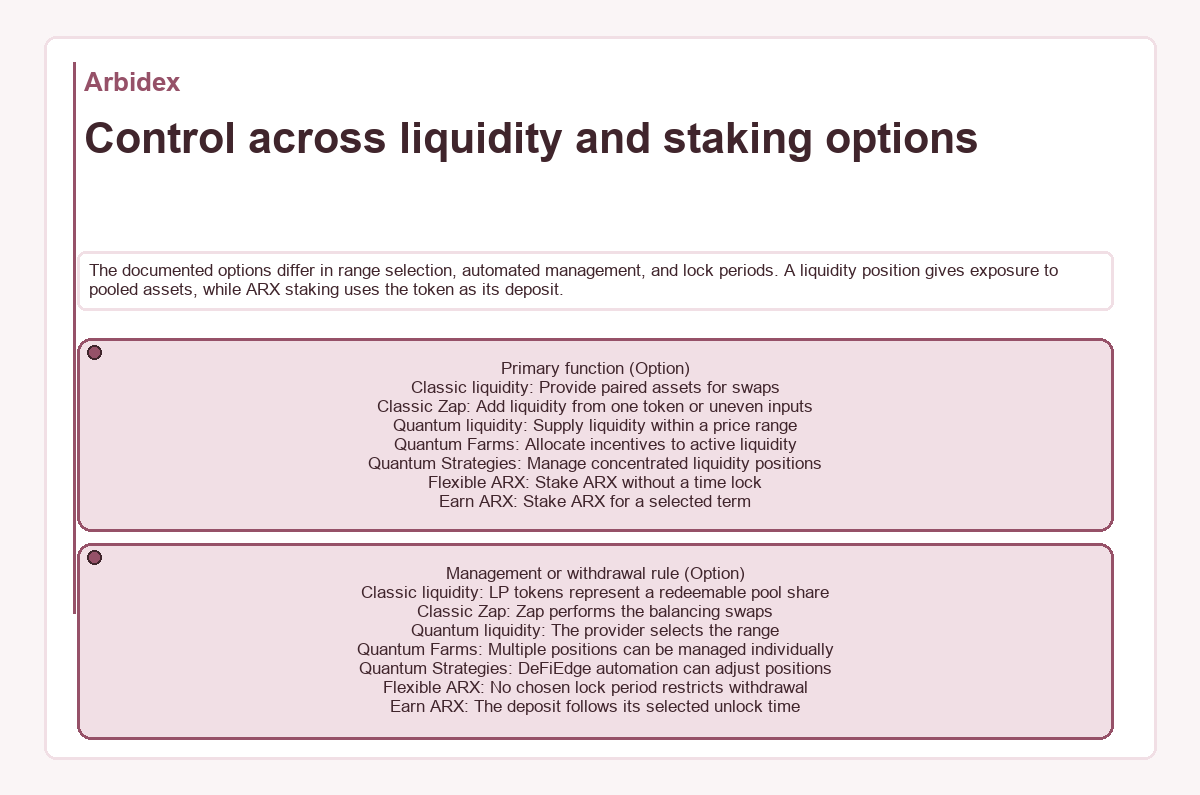
| Option | Primary function | Management or withdrawal rule |
|---|---|---|
| Classic liquidity | Provide paired assets for swaps | LP tokens represent a redeemable pool share |
| Classic Zap | Add liquidity from one token or uneven inputs | Zap performs the balancing swaps |
| Quantum liquidity | Supply liquidity within a price range | The provider selects the range |
| Quantum Farms | Allocate incentives to active liquidity | Multiple positions can be managed individually |
| Quantum Strategies | Manage concentrated liquidity positions | DeFiEdge automation can adjust positions |
| Flexible ARX | Stake ARX without a time lock | No chosen lock period restricts withdrawal |
| Earn ARX | Stake ARX for a selected term | The deposit follows its selected unlock time |
Practical questions about Arbidex
Does Arbidex use a centralized intermediary for Classic swaps?
Classic swaps use a non-custodial automated market maker without a centralized exchange intermediary. Tokens trade against liquidity pools on Arbitrum. The non-custodial swap model remains distinct from the rules governing assets committed to a liquidity pool or staking position.
Can I withdraw Quantum farm liquidity without unstaking first?
The documented Quantum farm design permits liquidity withdrawals without first unstaking the position. It also permits claiming or reinvesting trading-fee rewards while the position remains staked. These position-management capabilities are separate from the active-range condition that determines eligibility for farming rewards.
Do ARX staking rewards compound automatically?
The documented Earn ARX and Flexible ARX pools automatically compound ARX rewards. Separate pools paying USDC, WETH, and WBTC provide rewards that stakers harvest, with no automatic compounding.
What happens if I cancel an xARX redemption?
Canceling an xARX redemption retains the full xARX amount and generates no ARX from that canceled redemption. The cancellation option applies at any point during the redemption process.
How is ARX converted into xARX?
ARX converts immediately into xARX at a 1:1 ratio. The resulting xARX is an escrowed token with separate redemption terms. Converting it back to ARX requires vesting, with the selected duration determining how much ARX the redemption returns.