 Arbidex
 supports token swaps, liquidity deposits, and ARX staking for different asset needs
Arbidex supports different jobs through token swaps, paired liquidity positions, and single-sided ARX staking. Use a swap when the required outcome is another spendable token on Arbitrum. Liquidity fits participation in pool trading fees, with Quantum positions earning only within their chosen price range. ARX staking suits a token balance committed to a reward pool under its withdrawal terms. The choice turns on the asset needed afterward, range management, and access to principal.
Token swaps for a spendable asset
A token swap fits a job that requires a different spendable asset, provided the selected Arbitrum route offers an acceptable exchange. Smart Order Routing (SOR) considers Classic and Quantum liquidity alongside gas costs and slippage. Pool fees also affect route selection. The relevant outcome is the received token amount, with network gas assessed separately. A limit order fits a target-price requirement where waiting is acceptable; placing an order does not establish a completed exchange.
Paired liquidity and a chosen price range
Liquidity provision suits holders willing to accept ongoing exposure to a token pair in exchange for a share of the pool's trading fees.
Classic pool shares
Classic liquidity covers the full price range without a custom interval. A deposit creates liquidity provider (LP) tokens representing a proportional pool share. Zap supports a single-token contribution by swapping and balancing the paired assets to a 50/50 split before adding liquidity. That convenience concerns the deposit format: the resulting position still holds exposure to both assets. A single-token input therefore suits paired liquidity only when that pool exposure matches the intended holding.
The pool earns fees when traders use its liquidity. A completed deposit establishes the pool share; it does not establish how much fee income the share will earn.
Quantum range exposure
Quantum liquidity lets providers concentrate capital within a selected price band. Quantum farms allocate ARX rewards only to positions whose configured price range contains the current market price. Among active positions in the same farm, a narrower range increases the relative reward share for equal underlying token amounts. Narrower ranges also give the market less room to move before the position becomes inactive.
An out-of-range position stops earning trading fees and holds one of the pair's assets. Price re-entry can make it active again. A range adjusted to include the market price can also restore active liquidity. Willingness to monitor the selected band therefore affects whether this position fits the job.
Delegated range management
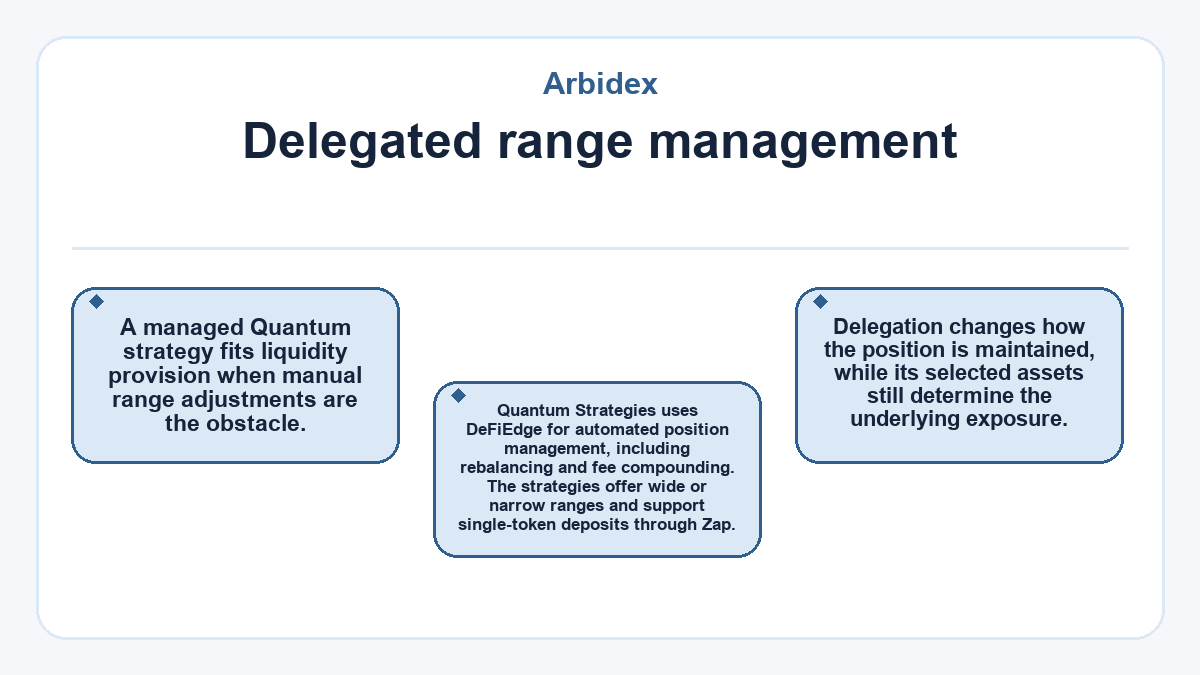
A managed Quantum strategy fits liquidity provision when manual range adjustments are the obstacle. Quantum Strategies uses DeFiEdge for automated position management, including rebalancing and fee compounding. The strategies offer wide or narrow ranges and support single-token deposits through Zap. Delegation changes how the position is maintained, while its selected assets still determine the underlying exposure.
Which ARX staking option fits your withdrawal needs?
Flexible ARX and the blue chip reward pools suit an unlocked stake; Earn ARX suits principal that can remain committed until the selected unlock date. The reward token and compounding behavior distinguish these choices further.
ARX rewards and a selected lock
Earn ARX offers lock periods from one week to one year. The interface shows the unlock date and time for the selected term. That date determines whether a locked stake fits a known need for the principal. Flexible ARX leaves the stake unlocked. The ARX reward pools compound automatically, including the flexible and locked choices. Auto-compounding reinvests rewards; it does not shorten the selected lock.
Staking ARX for other reward tokens
Single-sided ARX staking also includes pools paying USDC, WETH, WBTC, or ARB. The reward choice changes the token earned while the deposited principal remains ARX. These blue chip pools have no lock period and use Harvest for claims; they do not auto-compound rewards. This option fits earning a selected reward token without creating a paired liquidity position. It retains the price exposure of the ARX stake.
A spendable balance before a liquidity commitment
A swap fits a job that requires a spendable output token before another commitment; a Classic Zap deposit fits a job that requires paired liquidity.
Suppose the next action requires a particular token balance that remains free to use. Both routes can begin with a single input token, so the entry format cannot settle the choice. Define the required asset and amount before authorizing either route, then check these conditions.
- The selected asset and network match the balance needed for the next action.
- The input tokens are available in the connected Arbitrum wallet.
- The quoted swap output satisfies the required token amount.
- Pool fees and slippage leave at least the required token amount, and the wallet can cover gas.
- A completed swap and the resulting spendable balance can be checked before any staking or liquidity deposit.
For this job, choose the swap. Continue only after the trade has completed and the spendable output balance meets the required amount. A submitted action alone does not meet that condition. A Classic LP token would confirm a pool share, which becomes the fitting result only if the job changes to providing liquidity.
Exit conditions that change the choice
An intended exit date can rule out a staking lock or xARX redemption schedule even when the reward asset suits the job. Locked Earn ARX principal becomes available to withdraw when the lock ends. Redeeming an existing balance of escrowed ARX (xARX) requires a separate vesting period, with the ARX amount linked to the chosen redemption duration. A shorter redemption can return fewer ARX tokens, with the unredeemed difference burned.
Removing liquidity returns the assets represented by the pool share in their current composition. Trading and price movements can change those amounts during the holding period. A requirement to recover the original quantities of both tokens may therefore conflict with the liquidity position's actual outcome. Trading fees do not guarantee recovery of the original token quantities. When the next job requires one particular spendable asset, an exit from paired liquidity can leave a further token exchange to complete.
Still wondering about Arbidex?
-
Why can the same pair have more than one Quantum swap fee?
- Quantum permits a token pair to have pools at different fee tiers. Each pool's tier belongs to that pool, so a pair name alone does not identify its fee. Available liquidity, slippage, and gas costs also enter route selection; a higher fee tier does not establish a better trade.
-
Do I need a different Quantum farm for each position in the same pair?
- Quantum supports multiple liquidity positions for the same token pair within a single farm. The positions can be managed individually, so choosing another range does not inherently require another farm. Each position still has its own configured range, and ARX reward eligibility follows whether that position is active.
-
Can I add more ARX to an existing locked stake?
- The locked-staking interface supports adding ARX to an existing position through Add ARX. Extend is the separate control for lengthening an existing lock. These controls change different aspects of the position, so the recorded stake amount and unlock date are the relevant details when assessing an addition.
-
Does the displayed ROI fix what an Earn ARX lock will return?
- The Earn ARX return on investment (ROI) display uses the current token price and annual percentage rate (APR). That estimate does not fix the future value of the reward. The unlock date answers a separate question: when the locked ARX principal becomes accessible.
-
How long does xARX vest before it redeems into a full ARX amount?
- Full 1:1 xARX redemption uses the maximum vesting duration of six months. The minimum 15-day option returns 0.5 ARX per xARX. Choosing a duration below the maximum reduces the redemption ratio, and the excess ARX is burned. These are redemption terms, separate from an ARX staking pool's lock.
-
What establishes eligibility for Classic LP farming rewards?
- Classic farming requires LP tokens to be staked in the selected farm. The LP tokens represent a share of the underlying liquidity pool, while the farm stake establishes participation in its ARX incentives. A wallet's LP token balance alone does not demonstrate that the corresponding farm stake exists.